PrintDates

Try “bears”, “hallmark”, “AP exams” or “moon 2027”.

Sky calendar, 2027

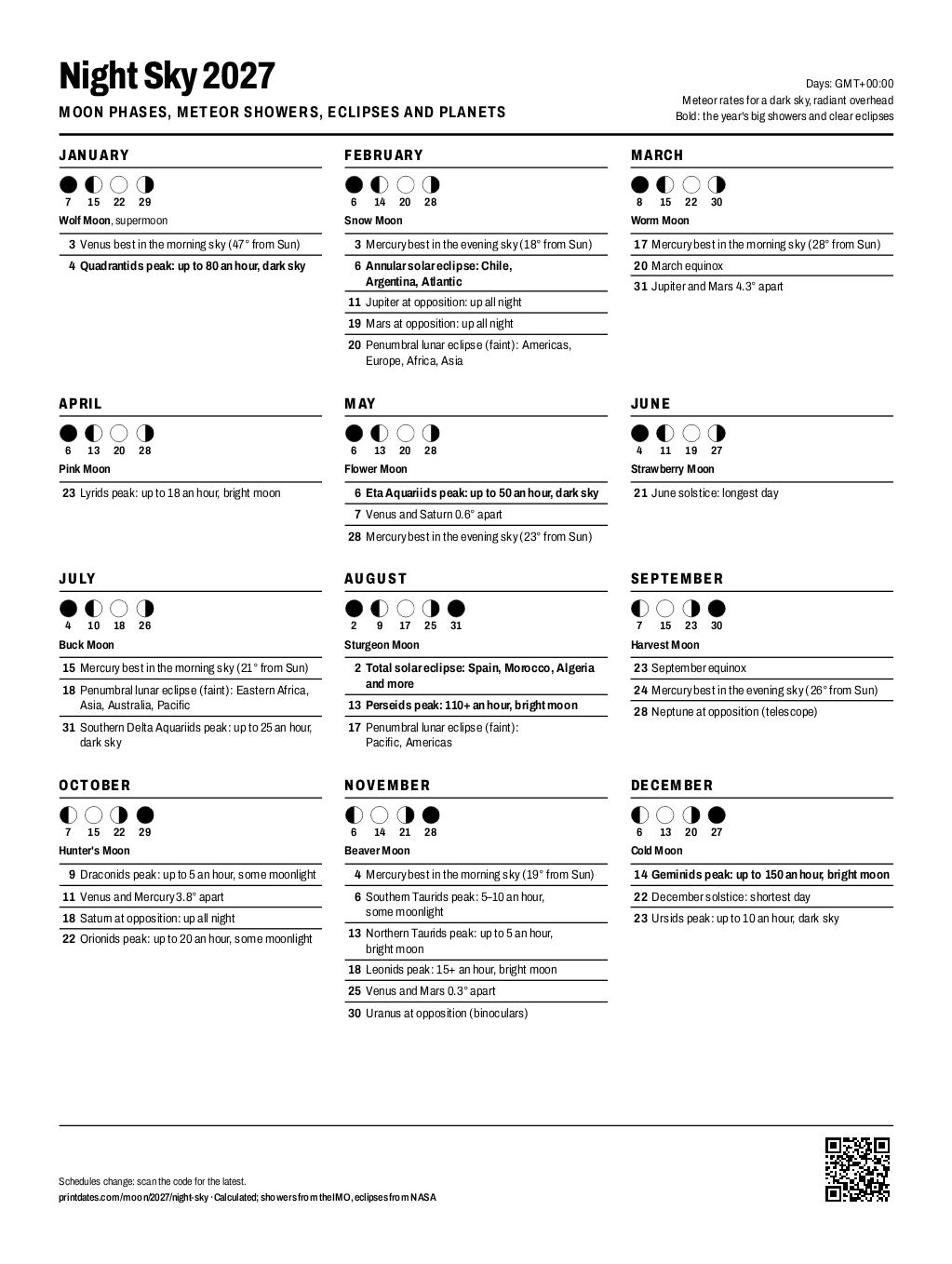
Night sky calendar 2027 meteor showers, eclipses and planets, month by month

12 meteor showers 5 eclipses 5 planets at opposition

Night Sky 2027

Moon phases, meteor showers, eclipses and planets

Days: Eastern Time (ET)

Meteor rates for a dark sky, radiant overhead

Bold: the year's big showers and clear eclipses

January

  1. New moon,7
  2. First quarter,15
  3. Full moon,22
  4. Last quarter,29

Wolf Moon, supermoon

  • 3Venus best in the morning sky (47° from Sun)
  • 3Quadrantids peak: up to 80 an hour, dark sky

February

  1. New moon,6
  2. First quarter,14
  3. Full moon,20
  4. Last quarter,28

Snow Moon

  • 3Mercury best in the evening sky (18° from Sun)
  • 6Annular solar eclipse: Chile, Argentina, Atlantic
  • 10Jupiter at opposition: up all night
  • 19Mars at opposition: up all night
  • 20Penumbral lunar eclipse (faint): Americas, Europe, Africa, Asia

March

  1. New moon,8
  2. First quarter,15
  3. Full moon,22
  4. Last quarter,29

Worm Moon

  • 17Mercury best in the morning sky (28° from Sun)
  • 20March equinox
  • 31Jupiter and Mars 4.3° apart

April

  1. New moon,6
  2. First quarter,13
  3. Full moon,20
  4. Last quarter,28

Pink Moon

  • 22Lyrids peak: up to 18 an hour, bright moon

May

  1. New moon,6
  2. First quarter,13
  3. Full moon,20
  4. Last quarter,28

Flower Moon

  • 6Eta Aquariids peak: up to 50 an hour, dark sky
  • 7Venus and Saturn 0.6° apart
  • 28Mercury best in the evening sky (23° from Sun)

June

  1. New moon,4
  2. First quarter,11
  3. Full moon,18
  4. Last quarter,27

Strawberry Moon

  • 21June solstice: longest day

July

  1. New moon,3
  2. First quarter,10
  3. Full moon,18
  4. Last quarter,26

Buck Moon

  • 15Mercury best in the morning sky (21° from Sun)
  • 18Penumbral lunar eclipse (faint): Eastern Africa, Asia, Australia, Pacific
  • 31Southern Delta Aquariids peak: up to 25 an hour, dark sky

August

  1. New moon,2
  2. First quarter,9
  3. Full moon,17
  4. Last quarter,24
  5. New moon,31

Sturgeon Moon

  • 2Total solar eclipse: Spain, Morocco, Algeria and more
  • 13Perseids peak: 110+ an hour, bright moon
  • 17Penumbral lunar eclipse (faint): Pacific, Americas

September

  1. First quarter,7
  2. Full moon,15
  3. Last quarter,23
  4. New moon,29

Harvest Moon

  • 23September equinox
  • 24Mercury best in the evening sky (26° from Sun)
  • 28Neptune at opposition (telescope)

October

  1. First quarter,7
  2. Full moon,15
  3. Last quarter,22
  4. New moon,29

Hunter's Moon

  • 9Draconids peak: up to 5 an hour, some moonlight
  • 11Venus and Mercury 3.8° apart
  • 17Saturn at opposition: up all night
  • 22Orionids peak: up to 20 an hour, some moonlight

November

  1. First quarter,6
  2. Full moon,13
  3. Last quarter,20
  4. New moon,27

Beaver Moon

  • 4Mercury best in the morning sky (19° from Sun)
  • 6Southern Taurids peak: 5–10 an hour, some moonlight
  • 13Northern Taurids peak: up to 5 an hour, bright moon
  • 18Leonids peak: 15+ an hour, bright moon
  • 24Venus and Mars 0.3° apart
  • 30Uranus at opposition (binoculars)

December

  1. First quarter,6
  2. Full moon,13
  3. Last quarter,20
  4. New moon,27

Cold Moon

  • 14Geminids peak: up to 150 an hour, bright moon
  • 21December solstice: shortest day
  • 22Ursids peak: up to 10 an hour, dark sky
Updated October 14, 2026. Schedules change: scan the code for the latest.

printdates.com/moon/2027/night-sky · Calculated; showers from the IMO, eclipses from NASA

Meteor showers in 2027

The rate is how many meteors an hour you'd see under a perfectly dark sky with the shower's radiant overhead; expect fewer. A bright moon on the peak night hides all but the brightest. The dark-sky peaks this year: Quadrantids, Eta Aquariids, Southern Delta Aquariids and Ursids.

ShowerPeakRateMoonActive
QuadrantidsJan 3, 10:25 PMup to 80/hrdark sky (10% lit)Dec 28 – Jan 12
LyridsApr 22, 9:40 PMup to 18/hrbright moon (93% lit)Apr 14 – Apr 30
Eta AquariidsMay 6, 5 AMup to 50/hrdark sky (0% lit)Apr 19 – May 28
Southern Delta AquariidsJul 31up to 25/hrdark sky (6% lit)Jul 12 – Aug 23
PerseidsAug 13, 5 AM110+/hrbright moon (88% lit)Jul 17 – Aug 24
DraconidsOct 9, 3 AMup to 5/hrsome moonlight (69% lit)Oct 6 – Oct 10
OrionidsOct 22up to 20/hrsome moonlight (53% lit)Oct 2 – Nov 7
Southern TauridsNov 65–10/hrsome moonlight (52% lit)Sep 20 – Nov 20
Northern TauridsNov 13up to 5/hrbright moon (99% lit)Oct 20 – Dec 10
LeonidsNov 18, 1 AM15+/hrbright moon (78% lit)Nov 6 – Nov 30
GeminidsDec 14, 3 PMup to 150/hrbright moon (99% lit)Dec 4 – Dec 20
UrsidsDec 22, 11 PMup to 10/hrdark sky (19% lit)Dec 17 – Dec 26

Peak times are the International Meteor Organization's predictions, often good only to a few hours; the night before and after are worth a look too.

Eclipses in 2027

  • Annular solar eclipse, Saturday, February 6, 10:59 AM ET Partial: South America, Antarctica, western & southern Africa. Annular: Chile, Argentina, Atlantic.
  • Penumbral lunar eclipse (faint), Saturday, February 20, 6:12 PM ET Americas, Europe, Africa, Asia.
  • Penumbral lunar eclipse (faint), Sunday, July 18, 12:02 PM ET Eastern Africa, Asia, Australia, Pacific. Penumbral magnitude 0.0014: NASA lists it as the smallest penumbral lunar eclipse of the 21st century; practically undetectable.
  • Total solar eclipse, Monday, August 2, 6:06 AM ET Partial: Africa, Europe, Middle East, western & southern Asia.
  • Penumbral lunar eclipse (faint), Tuesday, August 17, 3:13 AM ET Pacific, Americas.

Never look at the Sun during a partial or annular eclipse without certified eclipse glasses.

Planets in 2027

At opposition a planet is opposite the Sun: up all night and at its closest and brightest. Mercury and Venus never stray far from the Sun; their greatest elongations are the best times to find them, low in the west after sunset or in the east before sunrise.

DateEventTime (ET)
Jan 3Venus best in the morning sky (47° from Sun)12:56 PM
Feb 3Mercury best in the evening sky (18° from Sun)1:20 AM
Feb 10Jupiter at opposition: up all night, magnitude -2.67:17 PM
Feb 19Mars at opposition: up all night, magnitude -1.210:44 AM
Mar 17Mercury best in the morning sky (28° from Sun)2:57 AM
Mar 31Jupiter and Mars 4.3° apartClosest that night
May 7Venus and Saturn 0.6° apartClosest that night
May 28Mercury best in the evening sky (23° from Sun)6:02 AM
Jul 15Mercury best in the morning sky (21° from Sun)3:30 PM
Sep 24Mercury best in the evening sky (26° from Sun)6:06 PM
Sep 28Neptune at opposition (telescope), magnitude 7.810:08 AM
Oct 11Venus and Mercury 3.8° apartClosest that night
Oct 17Saturn at opposition: up all night, magnitude -0.18:19 PM
Nov 4Mercury best in the morning sky (19° from Sun)4:55 AM
Nov 24Venus and Mars 0.3° apartClosest that night
Nov 30Uranus at opposition (binoculars), magnitude 5.64:08 AM

Pairings are listed when two of the bright planets come within 5° of each other far enough from the Sun to see.

Night sky calendar 2027: moon phases, meteor showers, eclipses and planets, month by month on one printable page
The printed page, as the PDF prints it. Save to Pinterest

About this calendar

The moon's phases and the planets' events are calculated with astronomy-engine and checked against published almanacs (the US Naval Observatory, Fred Espenak's AstroPixels). Meteor showers are the International Meteor Organization's predictions for 2027; eclipses are NASA's. The year's strongest showers are the Quadrantids, Eta Aquariids, Perseids and Geminids.

Days and times follow your time zone: a shower peaking before dawn in New York may be the previous evening farther west. Pick your zone above the sheet and it redraws.

Sources: International Meteor Organization, 2027 Meteor Shower Calendar (IMO INFO(3-26), ed. Jurgen Rendtel), PDF, IMO 2027 calendar landing page, NASA GSFC (Fred Espenak), Solar Eclipses 2021-2030, NASA GSFC, Lunar Eclipses 2021-2030 and more, checked October 14, 2026.