Moon phase today, Saturday, November 28
Waning gibbous
79% of the moon's face is lit, and shrinking.
Next main phases, ET
- Last quarter Tuesday, December 1
1:09 AM - New moon Tuesday, December 8
7:53 PM - First quarter Thursday, December 17
12:43 AM - Cold Moon Wednesday, December 23
8:29 PM
Printable moon phase calendars
12 months on one page, as a PDF or in your calendar app
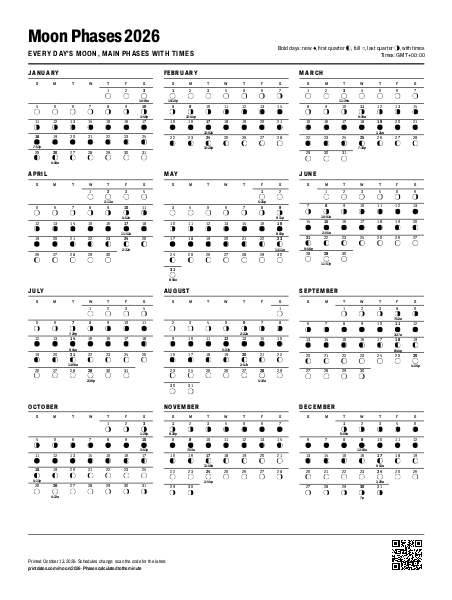
- This year Moon phase calendar 2026 Every day's moon, drawn
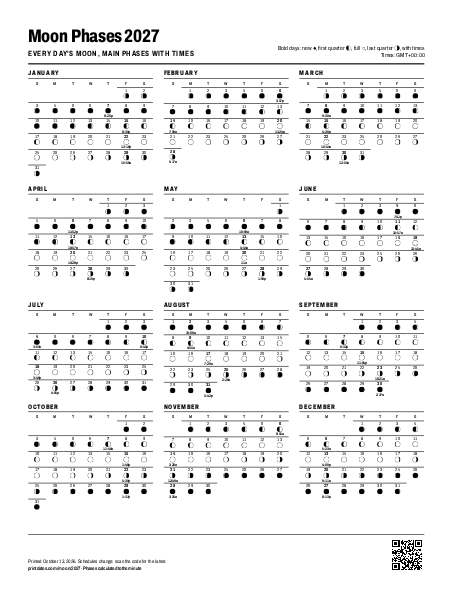
- Next year Moon phase calendar 2027 Every day's moon, drawn
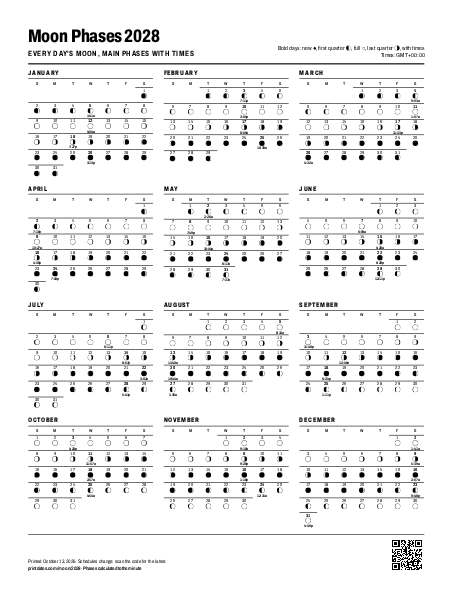
- 2028 Moon phase calendar 2028 Every day's moon, drawn
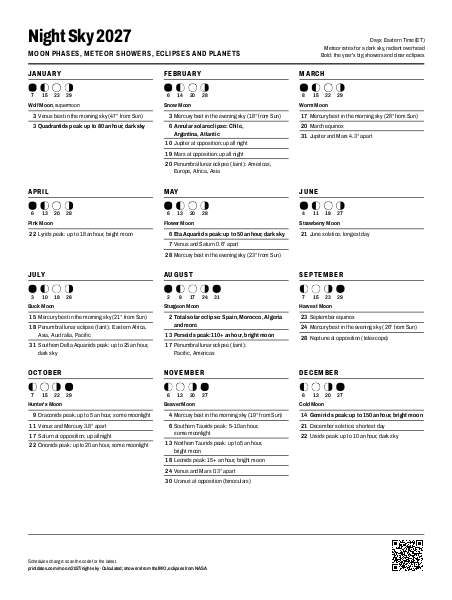
- Meteor showers, eclipses, planets Night sky calendar 2027 Month by month on one page
- Any day since 1900 The sky on your date A birthday, a wedding, the night you met
Full moons ahead
Times in ET; a blue ring marks a supermoon
- Cold Moon Wednesday, December 23, 8:29 PM, supermoon
- Wolf Moon Friday, January 22, 7:18 AM, supermoon
- Snow Moon Saturday, February 20, 6:24 PM
- Worm Moon Monday, March 22, 6:44 AM
- Pink Moon Tuesday, April 20, 6:28 PM
- Flower Moon Thursday, May 20, 7 AM
How the Moon's phases work, and why the date depends on where you are
The Sun always lights half the Moon. The phases are how much of that lit half faces us as the Moon circles Earth: none at new moon, when it sits between us and the Sun and is up all day, unseen; all of it at full moon, when it rises as the Sun sets and stays up all night.
A month of 29½ days, give or take
New moon to new moon takes 29 days, 12 hours and 44 minutes on average, but no two are alike. In 2027 the shortest runs 29 days and 7 hours (the one starting in early July) and the longest 29 days and 19½ hours (early January). Because the cycle is shorter than a calendar month, each phase lands about a day earlier each month, and every two or three years a month fits two full moons.
A phase is a moment, not a day
The four main phases (new, first quarter, full, last quarter) are instants, the same moment everywhere, so the date you write down depends on your clock. The full moon of June 18, 2027 comes at 8:45 PM in New York and 5:45 PM in Los Angeles, but at 1:45 AM on June 19 in London. September 15 and November 13 do the same. A calendar printed for another time zone can be a day off, which is why the moon calendars here show your own zone. To the eye the Moon looks full for about a day either side of the moment.
Blue moons
The phrase has two meanings, and they rarely agree:
- The second full moon in a calendar month, the meaning most people use. The last was May 31, 2026; the next is December 31, 2028 (in US Eastern time). There's none in 2027.
- The third full moon in a season that has four, the older meaning, counting a season from an equinox to a solstice or back. Spring 2027 has four full moons, from March 22 to June 18, so May 20, 2027 is a blue moon by this count.
Neither turns the Moon blue.
Where the names come from
Wolf, Snow, Worm, Pink, Flower, Strawberry, Buck, Sturgeon, Corn, Hunter's, Beaver and Cold: the names on these calendars are the ones almanacs collected from Native American, Colonial American and European traditions. They aren't astronomical terms, and tribes and regions used many others. One is set by the sky rather than the month: the Harvest Moon is the full moon nearest the September equinox, and the Hunter's Moon the one after it. In 2027 the equinox is September 23, so the Harvest Moon is September 15 and the Hunter's Moon October 15.
Eclipses in 2027
An eclipse needs a full moon (lunar) or a new moon (solar) that falls where the Moon's tilted orbit crosses the Sun's path, which happens only a few times a year. 2027 has two solar eclipses: an annular one on February 6 over South America and the South Atlantic, and a total one on August 2 across southern Spain, North Africa and Arabia, with up to 6 minutes 23 seconds of totality in Egypt. It also has three penumbral lunar eclipses, which only dim the Moon slightly; North America can see the ones on February 20 and August 17. There's no total lunar eclipse in 2027.
How these calendars are made
The phases are calculated from the Moon's orbit with the Astronomy Engine library, not copied from a table, and agree with the US Naval Observatory's times to within a minute. Each calendar is then drawn for your time zone, so the date of each phase is the one on your own clock.
Written by PrintDates and checked November 17, 2026 against NASA on the Moon's phases, NASA on seasonal blue moons, NASA's eclipse tables, the US Naval Observatory's phase tables and the Old Farmer's Almanac's full moon names. Found a mistake? Email hello@printdates.com.